Authentic Korean Kimchi Recipe Easy Homemade Flavorful Guide
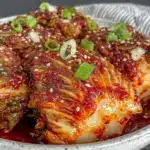
This authentic Korean kimchi recipe is approachable, flavorful, and perfect for anyone ready to add a homemade kick to their meals. It combines simple ingredients to create a vibrant, tangy, and mildly spicy fermented side dish.
- Prep Time: 30 minutes
- Cook Time: 0 minutes
- Total Time: 1.5 to 2 hours prep + 1-5 days fermentation
- Yield: About 8 servings 1x
- Category: Side Dish
- Cuisine: Korean
Ingredients
- 2 medium heads napa cabbage (about 3 lbs / 1.4 kg)
- 1/2 cup kosher salt or sea salt (120 g)
- About 6 cups water (1.4 liters)
- 1/2 cup Korean red pepper flakes (gochugaru) (40 g)
- 8 cloves garlic, minced
- 2 tablespoons freshly grated ginger
- 4–5 stalks green onions, chopped into 1-inch pieces
- 1/4 cup fish sauce (60 ml) (substitute soy sauce or tamari for vegan)
- 1 tablespoon sugar
- 1 cup Korean radish (mu), julienned (or daikon radish)
- 1 small Asian pear, grated (optional)
Instructions
- Remove any damaged outer leaves from the napa cabbages. Cut each head into quarters lengthwise, then chop into 2-inch pieces. Rinse under cold water.
- In a large bowl, dissolve 1/2 cup kosher salt in 6 cups cold water. Submerge the cabbage pieces fully in the brine. Let sit for 1.5 to 2 hours, tossing every 30 minutes to ensure even salting.
- After salting, rinse the cabbage thoroughly under cold water to remove excess salt. Drain well in a colander for about 20 minutes. Squeeze gently to remove extra water but don’t crush the leaves.
- In a medium bowl, combine 1/2 cup gochugaru, minced garlic, grated ginger, fish sauce, sugar, and grated pear (if using). Stir to make a thick, spicy paste. Adjust chili flakes to taste.
- Add the chopped radish and green onions to the paste. Using gloved hands, mix everything thoroughly until well coated.
- Add the drained cabbage to the bowl with the kimchi paste. Wearing gloves, massage and toss everything together until the cabbage pieces are evenly coated, about 5-7 minutes.
- Transfer the kimchi into your fermentation jar, pressing down firmly to remove air pockets. Leave 1-2 inches of headspace at the top. Place a weight on top to keep the vegetables submerged.
- Seal the jar loosely or cover with a cloth to allow gases to escape. Leave at room temperature (65-72°F) for 1-5 days depending on taste preference. Check daily for bubbles or tang.
- Once desired fermentation is reached, tighten the lid and refrigerate. Flavors will continue to develop slowly in the fridge for several weeks.
Notes
[‘Salting the cabbage thoroughly is key to softening and preventing sogginess.’, ‘Use fresh gochugaru for best flavor and vibrant color.’, ‘Wear gloves to protect your hands from chili irritation and for hygiene.’, ‘Keep cabbage submerged under its own juices during fermentation to avoid mold.’, ‘Fermentation time varies by temperature and taste preference; taste daily.’, ‘If white kahm yeast forms, skim it off; avoid mold or off smells.’, ‘Kimchi can be eaten fresh without fermentation as a spicy salad.’, ‘For vegan kimchi, substitute fish sauce with tamari or soy sauce.’, ‘Store kimchi refrigerated in an airtight jar for up to 3 months.’]
Nutrition
- Serving Size: Approximately 1/2 cu
- Calories: 25
- Sugar: 2
- Sodium: 600
- Fat: 0.2
- Carbohydrates: 5
- Fiber: 2
- Protein: 1
Keywords: kimchi, Korean kimchi, fermented vegetables, homemade kimchi, spicy kimchi, gochugaru, napa cabbage, probiotic foods